
The last few days I was hearing someone singing Do, Re, Mi, Fa, Sol, La, Ti and Do; and I was wondering What the hell does that mean? If your answer is yes, the solfege meaning would unlock doors of improving music learning, ear training and singing skills.
One of the most effectively used by music teachers around the world is Solfege. If you are a beginner learning music for the first time or if you are a singer working and studying to improve perfect pitch, solfege allows you to understand melodies and relationships between sounds in music as easy as a breeze. This comprehensive guide will teach you solfege meaning, history, how it works, why it’s such a useful tool and the various systems for using it as well as how beginners can begin using today.
What Is Solfege?
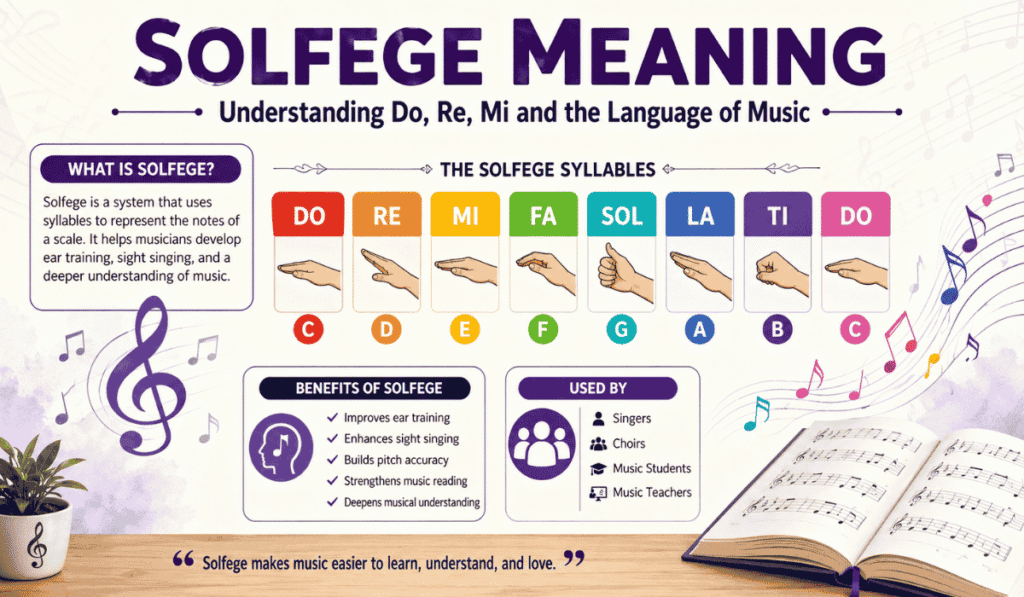
Meaning of solfege in solfeggio Solfege meaning is a music education method that uses the syllables instead of letter names as note names on a scale. The most common syllables are:
In the beginning you get trained up(via data) to something like Do – Re – Mi – Fa – Sol – La – Ti- Do.
Each syllable represents a corresponding degree of the musical scale and aids in recognizing pitches, intervals, and melodies, which makes musicians better at these tasks. Commonly used in sight-singing, ear training, and music theory education. In other words, solfege serves singers better as it relieves them from using the keys of instruments or letters that dictate notes..
Quick Facts About Solfege
| Feature | Details |
| Meaning | A system of singing and identifying musical notes using syllables |
| Common Syllables | Do, Re, Mi, Fa, Sol, La, Ti |
| Purpose | Ear training, sight singing, pitch recognition |
| Origin | Medieval Europe |
| Used By | Singers, choirs, music students, teachers |
| Alternative Name | Solfège or Solfeggio |
| Popular In | Music schools and conservatories worldwide |
Solfege Meaning in Simple Words
To understand the meaning of solfege, imagine learning a language. Before reading complex sentences, children learn simple sounds and words.
Music works similarly.
Instead of remembering note letters such as C, D, E, F, G, A, and B, musicians use:
- Do
- Re
- Mi
- Fa
- Sol
- La
- Ti
These syllables make notes easier to sing and remember. Because each syllable contains clear vowel sounds, singers can accurately hear and reproduce pitches. Many music educators consider solfege one of the best tools for developing musical ears.
Read More: Gyatt Meaning | Habibi Meaning
The History of Solfege
This history of solfege meaning is nearly a thousand years in the making.
Italian music theorist Guido of Arezzo devised a system in the 11th century to assist singers to learn melodies more rapidly. Each syllable is assigned a pitch level based on their input of the Latin stanza; he utilized syllables from a hymn in Latin. This system over time morphed into the system we use now. The first note was originally named Ut. Musicians soon started singing it as “Do,” which was less complicated to sing. This breakthrough transformed music education and is still popular in classrooms all over the world today.
The Solfege Scale Explained
The standard major scale in solfege looks like this:
| Solfege | Note Example in C Major |
| Do | C |
| Re | D |
| Mi | E |
| Fa | F |
| Sol | G |
| La | A |
| Ti | B |
| Do | C |
When singers practice scales using these syllables, they learn to recognize relationships between notes rather than memorizing individual pitches. This is a key aspect of the solfege meaning and why the method is so powerful.
Why Is Solfege Important?
Many beginners wonder why musicians use solfege when note letters already exist.
The answer lies in how humans hear music.
Solfege helps learners:
- Understand pitch relationships
- Improve singing accuracy
- Develop relative pitch
- Learn melodies faster
- Strengthen sight-reading skills
- Train the ear effectively
Music educators frequently use solfege because it allows students to hear and sing intervals naturally. Community discussions among musicians also highlight that solfege is easier to sing than letter names and helps build stronger musical understanding.
How Solfege Works
The solfege meaning becomes clearer when you see it in practice.
Suppose a melody uses these notes:
C – D – E – F – G
In solfege, you would sing:
Do – Re – Mi – Fa – Sol
Instead of focusing on note letters, you focus on the sound relationship between notes.
As a result, musicians become better at:
- Singing in tune
- Identifying melodies
- Hearing intervals
- Learning songs by ear
Types of Solfege Systems
There are two major solfege systems used around the world.
1. Movable Do
Movable Do is the most common teaching method.
In this system:
- Do always represents the first note of the scale.
- Re represents the second note.
- Mi represents the third note.
For example:
In C Major
- Do = C
In G Major
- Do = G
This approach helps students understand musical relationships regardless of key.
2. Fixed Do
In Fixed Do:
- Do is always C
- Re is always D
- Mi is always E
No matter which key is used, the syllables remain attached to the same notes.
Many European music schools use this approach.
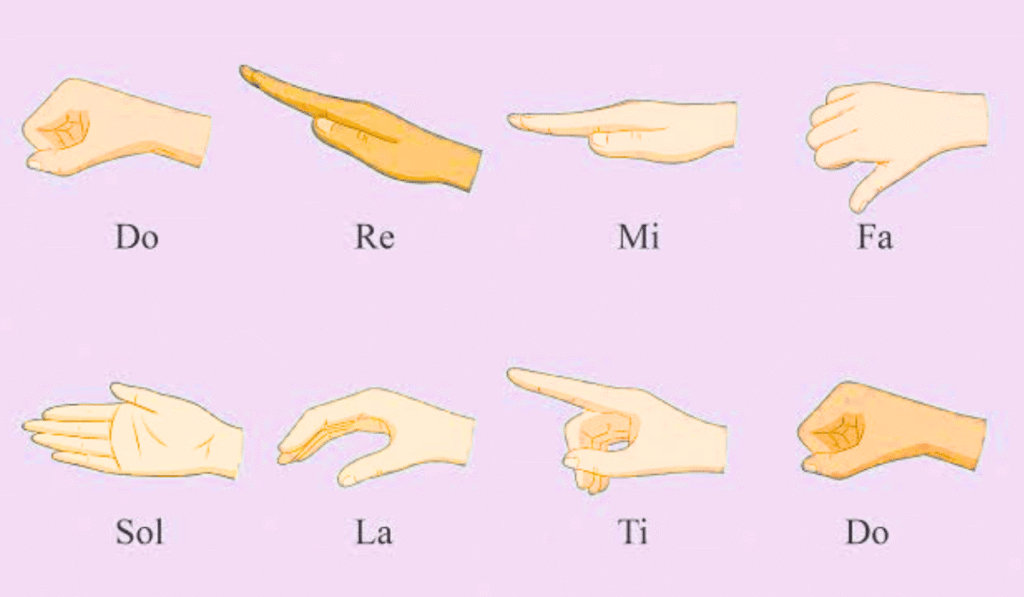
Solfege Hand Signs
Many music teachers combine solfege with hand signs.
Each syllable has a unique hand position.
| Solfege | Purpose of Hand Sign |
| Do | Establishes the tonal center |
| Re | Shows upward movement |
| Mi | Reinforces pitch recognition |
| Fa | Builds interval awareness |
| Sol | Strengthens pitch memory |
| La | Improves melodic understanding |
| Ti | Creates tension before resolution |
| Do | Returns to home pitch |
These visual cues help students connect hearing, singing, and physical movement.
Benefits of Learning Solfege
Understanding the solfege meaning becomes even more valuable when you see its benefits.
1. Better Ear Training
Students learn to recognize intervals and melodies quickly.
2. Improved Singing Accuracy
Solfege encourages precise pitch matching.
3. Faster Music Reading
Sight-singing becomes much easier.
4. Stronger Musical Memory
Melodies are easier to remember using syllables.
5. Better Understanding of Music Theory
Students naturally learn scales, intervals, and harmonic relationships.
Solfege and Sight Singing
Sight singing of music is one of the biggest reasons why we used Solfege in music teaching.
Sight singing is reading music and singing correctly without hearing it first.
And the use of solfege allows this to happen since students learn that particular syllables represent specific pitch relationships. Sight singing is one of the main uses for solfege training, as indicated by music education resources.
For example:
Instead of reading:
C – E – G
A student reads:
Do – Mi – Sol
This makes pitch recognition much easier.
Solfege vs Note Letters
| Solfege | Note Letters |
| Do | C |
| Re | D |
| Mi | E |
| Fa | F |
| Sol | G |
| La | A |
| Ti | B |
Solfege Advantages
- Easier for singing
- Improves relative pitch
- Better ear training
- Helps sight singing
Letter Name Advantages
- Useful for instruments
- Common in written music
- Universal notation system
Most musicians learn both systems together.
How Beginners Can Practice Solfege
If you are new to music, start with these simple exercises.
Sing Major Scales Daily
Practice:
Do Re Mi Fa Sol La Ti Do
Then sing downward:
Do Ti La Sol Fa Mi Re Do
Learn Simple Songs
Try singing familiar melodies using solfege syllables instead of lyrics.
Practice Intervals
Sing:
- Do–Mi
- Do–Sol
- Do–La
This improves pitch recognition.
Use Hand Signs
Combining hand movements with singing helps memory retention.
Listen and Identify Notes
Try recognizing which syllables appear in simple melodies.
Common Misconceptions About Solfege
Myth 1: Solfege Is Only for Children
False, Professional singers and musicians use solfege regularly.
Myth 2: Solfege Replaces Music Theory
False, Solfege supports music theory but does not replace it.
Myth 3: Solfege Is Outdated
False, Music schools and conservatories continue to use solfege because of its effectiveness in ear training and sight singing.
Is Solfege Still Relevant Today?
Absolutely. Contemporary music teachers have stuck with solfege for a very good reason: it teaches students to listen rather than just memorize.Whether for someone who wants to sing in a choir, play an instrument, compose music or improve musical hearing: knowing the solfege meaning is very useful anyway.
Many of today’s music education programs still include sight-singing as one of the primary tools for building listening skills and pitch awareness.
Conclusion
When we discuss the solfege meaning, it is much more than a collection of syllables as Do – Re – Mi – Fa – Sol – La – Ti. This is an amazing music learning platform where ear training, sight-singing ability development, pitch recognition and musical understanding are key in student training.
Solfege, from its origins in medieval Europe to its use today as a teaching tool in music classrooms everywhere, is one of the best tools anyone could have come up with. Regardless of your experience, solfege can boost your musical ability and confidence. Solfege would be the best way to begin if you have ever desired to sing more accurately, read music faster, or develop a better understanding of melodies.
FAQs Related to Solfege Meaning
1. What is the meaning of solfege in music?
The solfege meaning refers to a music education system that uses syllables such as Do, Re, Mi, Fa, Sol, La, and Ti to represent notes in a scale and help with ear training and sight singing.
2. Why is solfege important?
Solfege helps musicians improve pitch recognition, sight singing, ear training, and overall musical understanding.
3. What are the seven solfege syllables?
The seven primary solfege syllables are:
Do, Re, Mi, Fa, Sol, La, and Ti.
4. What is the difference between movable Do and fixed Do?
Movable Do changes based on the key of the music, while Fixed Do always assigns Do to the note C regardless of key.
5. Can adults learn solfege?
Yes. Adults can learn solfege effectively and use it to improve singing, ear training, and music-reading skills. Many professional musicians continue using solfege throughout their careers.